Document Type : Systematic Review
Authors
MD, Obstetrician and Gynecologist Surgeon, Tehran, Iran
Abstract
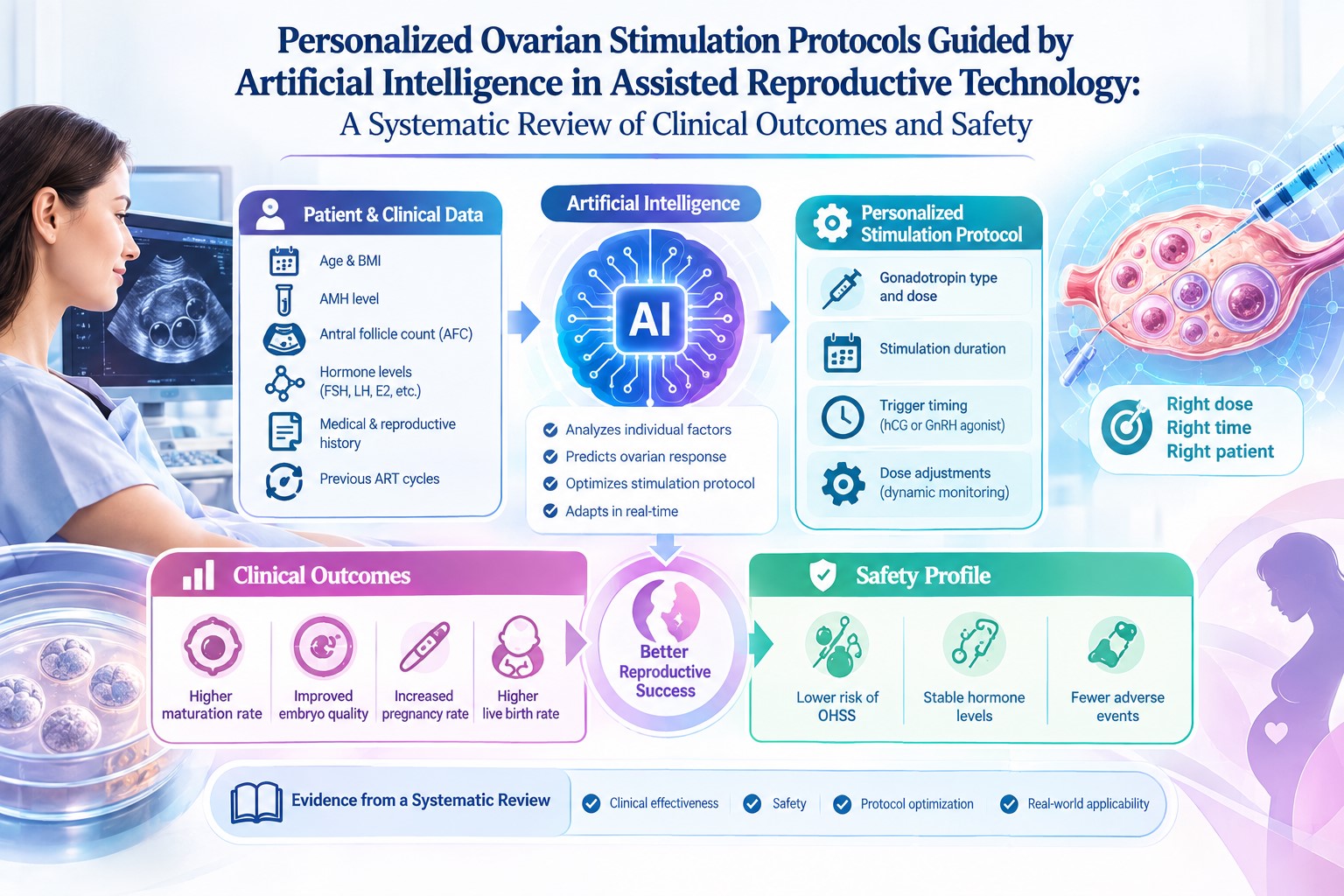
Background: Controlled ovarian stimulation (COS) is a critical component of assisted reproductive technology (ART), yet ovarian response remains highly heterogeneous despite the use of established biomarkers such as anti-Müllerian hormone (AMH) and antral follicle count (AFC). Artificial intelligence (AI), particularly machine learning (ML), has emerged as a potential decision-support technology for individualized gonadotropin dosing, prediction of oocyte yield, optimization of trigger timing, and selection of stimulation protocols. This systematic review synthesized current evidence concerning the clinical effectiveness, safety, and translational readiness of AI-guided personalized ovarian stimulation.
Methods: Published studies evaluating AI, ML, or algorithm-based personalization of ovarian stimulation in IVF/ICSI considered, with particular emphasis on gonadotropin starting-dose selection, mature oocyte prediction, trigger timing, ovarian response, live birth, clinical pregnancy, cycle cancellation, gonadotropin consumption, and ovarian hyperstimulation syndrome (OHSS). Evidence from randomized controlled trials (RCTs), prospective clinical studies, retrospective validation studies, systematic reviews, and relevant clinical guidelines synthesized narratively. Prediction-model quality and applicability considered using principles derived from PROBAST and emerging PROBAST+AI recommendations.
Results: AI models demonstrated promising predictive performance for ovarian response, total and mature oocyte yield, and trigger-day selection. Prospective clinical evidence remains limited. A multicenter prospective study involving 291 AI-assisted cycles reported 12.20 versus 11.24 MII oocytes and 16.01 versus 14.54 retrieved oocytes compared with historical controls, while total FSH exposure was 3671.95 versus 3846.29 IU; none of these differences reached statistical significance. Conventional individualized dosing trials demonstrated that reducing FSH in predicted hyper-responders reduced any-grade OHSS without reducing cumulative live birth, whereas increasing FSH in predicted poor responders did not improve cumulative live birth.
Conclusions: AI-guided ovarian stimulation is clinically promising but remains insufficiently validated for routine autonomous clinical decision-making. Current evidence supports AI primarily as a clinician-supervised decision-support technology. Large, prospective, externally validated, randomized trials incorporating live birth and safety outcomes are required before widespread implementation.
Graphical Abstract
Keywords
Subjects