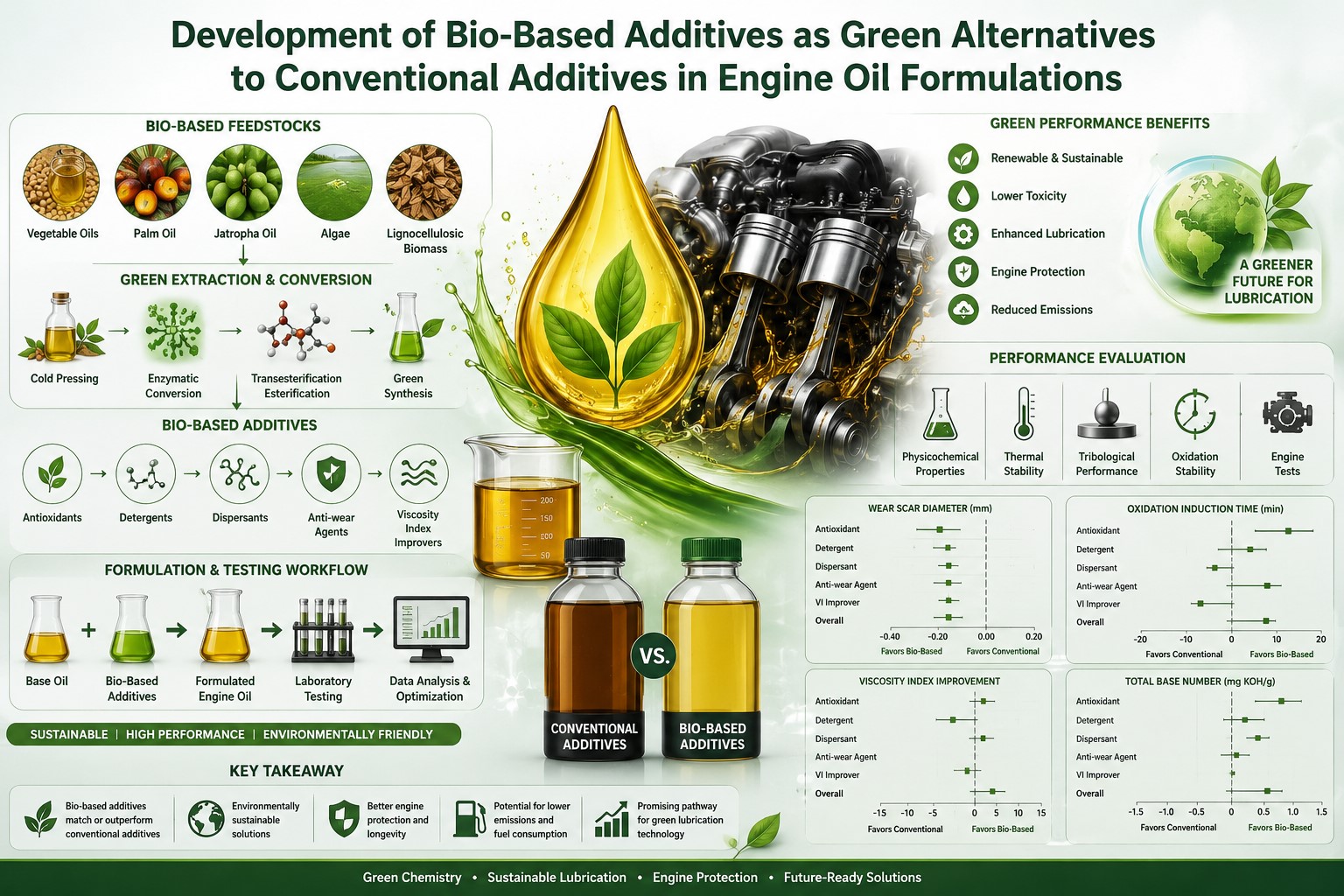
Development of Bio-Based Additives as Green Alternatives to Conventional Additives in Engine Oil Formulations

Document Type : Original Article

Authors

1 M.Sc. in Matrial Science Engineering and Metallurgy, Semnan University, Semnan, Iran; Deputy CEO of Ravan Gostaran Tavan Gharb Company

2 B.Sc. in Applied Chemistry, Islamic Azad University, South Tehran Branch, Tehran, Iran; CEO of Ravan Gostaran Tavan Gharb Company

3 M.Sc student in chemical engineering (Thermosynthetics & Catalysis), Sanandaj university, Sanandaj, Iran; Qc of Ravan Gostaran Tavan Gharb Company

Abstract
The development of bio-based lubricant additives represents a promising strategy for reducing the environmental footprint of engine oils while maintaining the physicochemical and tribological performance required in modern internal combustion engines. Conventional lubricant formulations commonly incorporate antioxidants, antiwear agents, friction modifiers, viscosity modifiers, detergents, and dispersants, several of which are derived from nonrenewable resources or raise concerns regarding persistence, toxicity, and end-of-life management. Bio-based alternatives obtained from vegetable oils, agricultural residues, lignocellulosic biomass, natural phenolic compounds, and other renewable feedstocks offer opportunities to improve lubricity, biodegradability, and resource efficiency. This review examines the mechanisms, performance characteristics, and limitations of these additives, emphasizing their potential application in engine oil formulations. The literature is evaluated in relation to four principal domains: tribological performance, oxidative and thermal stability, physicochemical compatibility, and environmental sustainability. Particular attention given to fatty-acid derivatives, natural antioxidants, chemically modified vegetable oils, bio-derived friction modifiers, and multifunctional additives. The methodological framework combines a structured narrative review with qualitative evidence mapping and comparative assessment of reported findings. Four analytical tables summarize additive classes, functional mechanisms, performance considerations, and formulation requirements. Because the identified studies employ heterogeneous materials, concentrations, test conditions, and performance indicators, the available evidence does not support the calculation of a defensible pooled effect size without additional standardized experimental data. Accordingly, forest-plot-style quantitative synthesis distinguished from qualitative evidence mapping. The review indicates that bio-based additives can provide useful lubricity and sustainability advantages, but their suitability for engine oils depends on oxidation resistance, low-temperature behavior, additive compatibility, deposit control, and compliance with engine-specific performance requirements. Future research should prioritize standardized testing, life-cycle assessment, and validation in fully formulated engine oils under representative operating conditions.

Graphical Abstract

Development of Bio-Based Additives as Green Alternatives to Conventional Additives in Engine Oil Formulations

Keywords

Subjects

[1]    Berman, D. (2024). Plant-based oils for sustainable lubrication solutions Review. Lubricants, 12(9), 300.            
[2]    Fox, N. J., & Stachowiak, G. W. (2007). Vegetable oil-based lubricants A review of oxidation. Tribology International, 40(7), 1035-1046.
[3]    Hamnas, A., & Unnikrishnan, G. (2023). Bio-lubricants from vegetable oils: Characterization, modifications, applications and challenges Review. Renewable and Sustainable Energy Reviews, 182, Article 113413.
[4]    Karmakar, G., Ghosh, P., & Sharma, B. K. (2017). Chemically modifying vegetable oils to prepare green lubricants. Lubricants, 5(4), 44.
[5]    Kumar, S. A., Suresh, G., Hariprasad, V., Deepak, G. S., Akhil, P. S., et al. (2021). Enhancement of oxidative stability and cold flow properties of coconut oil using natural antioxidant additives for development of bio-lubricant. Proceedings of the Institution of Mechanical Engineers, Part J: Journal of Engineering Tribology, 235(4).
[6]    Nogales-Delgado, S., Encinar, J. M., & González, J. F. (2023). A review on bio lubricants based on vegetable oils through transesterification and the role of catalysts: Current status and future trends. Catalysts, 13(9), 1299.      
[7]    Omolade, A. I., Mercy, O. A., Akeem, A. M., & Temitope, A. E. (2025). A review of the preparation, enhancement and properties of plant oil-based bio lubricant. Tropical Journal of Phytochemistry and Pharmaceutical Sciences, 3(9), 424-441.            
[8]    Panchal, T. M., Patel, A., Chauhan, D. D., Thomas, M., & Patel, J. V. (2017). A methodological review on bio-lubricants from vegetable oil-based resources. Renewable and Sustainable Energy Reviews, 70, 65-70.             
[9]    Patel, J. R., Chauhan, K. V., Rawal, S., Patel, N. P., & Subhedar, D. (2025). Advances and challenges in bio-based lubricants for sustainable tribological applications: A comprehensive review of trends, additives, and performance evaluation. Lubricants, 13(10), 440.
[10]Pendbhaje, G., Ali, M., & Bajaj, D. (2025). Bio-lubricants as viable replacements for mineral oils in automotive engines: A review. International Journal of Engine Research.
[11] Raof, N. A., Abd Hamid, H. A., Mohamad Aziz, N. A., & Yunus, R. (2022). Prospects of plant-based trimethylolpropane esters in the bio lubricant formulation for various applications: A review. Frontiers in Mechanical Engineering, 8, Article 833438.       
[12] Roegiers, M., & Zhmud, B. (2009). Tribological performance of ionised vegetable oils as lubricity and fatty oiliness additives in lubricants and fuels. Lubrication Science, 21(5), 169-182.
[13] Saka, A., Abor, T. K., Okafor, A. C., & Okoronkwo, M. U. (2025). Thermo-rheological and tribological properties of low- and high-oleic vegetable oils as sustainable bio-based lubricants. RSC Sustainability, 3, 1461-1476.
[14] Sancheti, S., et al. (2022). Synthesis of environment-friendly, sustainable, and nontoxic bio-lubricants: A critical review of advances and a path forward. Biofuels, Bioproducts and Biorefining.            
[15] Singh, A. K., & Singh, R. K. (2012). A search for ecofriendly detergent/dispersant additives for vegetable-oil based lubricants. Journal of Surfactants and Detergents. 
[16] Soodoo, N., Bouzidi, L., & Narine, S. S. (2023). Fundamental structure–function relationships in vegetable oil-based lubricants: A critical review. Lubricants, 11(7), 284.             
[18] Uppar, R., Dinesha, P., & Kumar, S. (2023). A critical review on vegetable oil-based bio-lubricants: Preparation, characterization, and challenges. Environment, Development and Sustainability, 25, 9011-9046.          
[19] Xia, D., Wang, Y., Liu, H., Yan, J., Lin, H., & Han, S. (2024). Research progress of antioxidant additives for lubricating oils. Lubricants, 12(4), 115.              
[20] A review on the chemistry, production, and technological potential of bio-based lubricants. (2018). Renewable and Sustainable Energy Reviews, 82, 80-102.    
[21] Tribological behavior of bio lubricant base stocks and additives. (2018). Renewable and Sustainable Energy Reviews, 93, 145-157.
[22] Environmentally friendly functional fluids from renewable and sustainable sources A review. (2018). Renewable and Sustainable Energy Reviews, 81(Part 2), 1787-1801.
[24] Designing lubricating properties of vegetable base oils. (2018). Molecules, 23(8), 2025.
[25] Green tribology assessment: A comprehensive review of bio-lubricants and nano enhancers. (2024). Energy Conversion and Management: X, 24, Article 100794.     

Articles in Press, Accepted Manuscript
Available Online from 22 October 2026