Liquid Biopsy for Early Detection of Colorectal Cancer: Circulating Tumor DNA and Exosomal Biomarkers

Document Type : Original Article

Author

Assistant Professor of Gastroenterology and Hepatology, Department of Internal Medicine, Clinical Research Development Unit, Hajar Hospital, Shahrekord University of Medical Sciences, Shahrekord, Iran

Abstract
Background: Colorectal cancer (CRC) remains a major cause of cancer-related morbidity and mortality worldwide. Although colonoscopy and stool-based screening tests have improved early detection, participation, invasiveness, and limited sensitivity for some precancerous lesions remain important challenges. Liquid biopsy offers a minimally invasive approach for detecting tumor-derived molecular signals in blood, particularly circulating tumor DNA (ctDNA) and Exosomal biomarkers.

Objective: This review evaluates the biological rationale, diagnostic performance, clinical applications, and limitations of ctDNA and exosome-derived biomarkers for early CRC detection.

Methods: A narrative evidence synthesis developed from peer-reviewed clinical studies, diagnostic accuracy investigations, systematic reviews, and meta-analyses. Evidence organized according to biomarker type, molecular detection method, clinical population, diagnostic accuracy, and translational readiness. Published diagnostic estimates distinguished from interpretive conclusions; no new-pooled estimate calculated from individual studies.

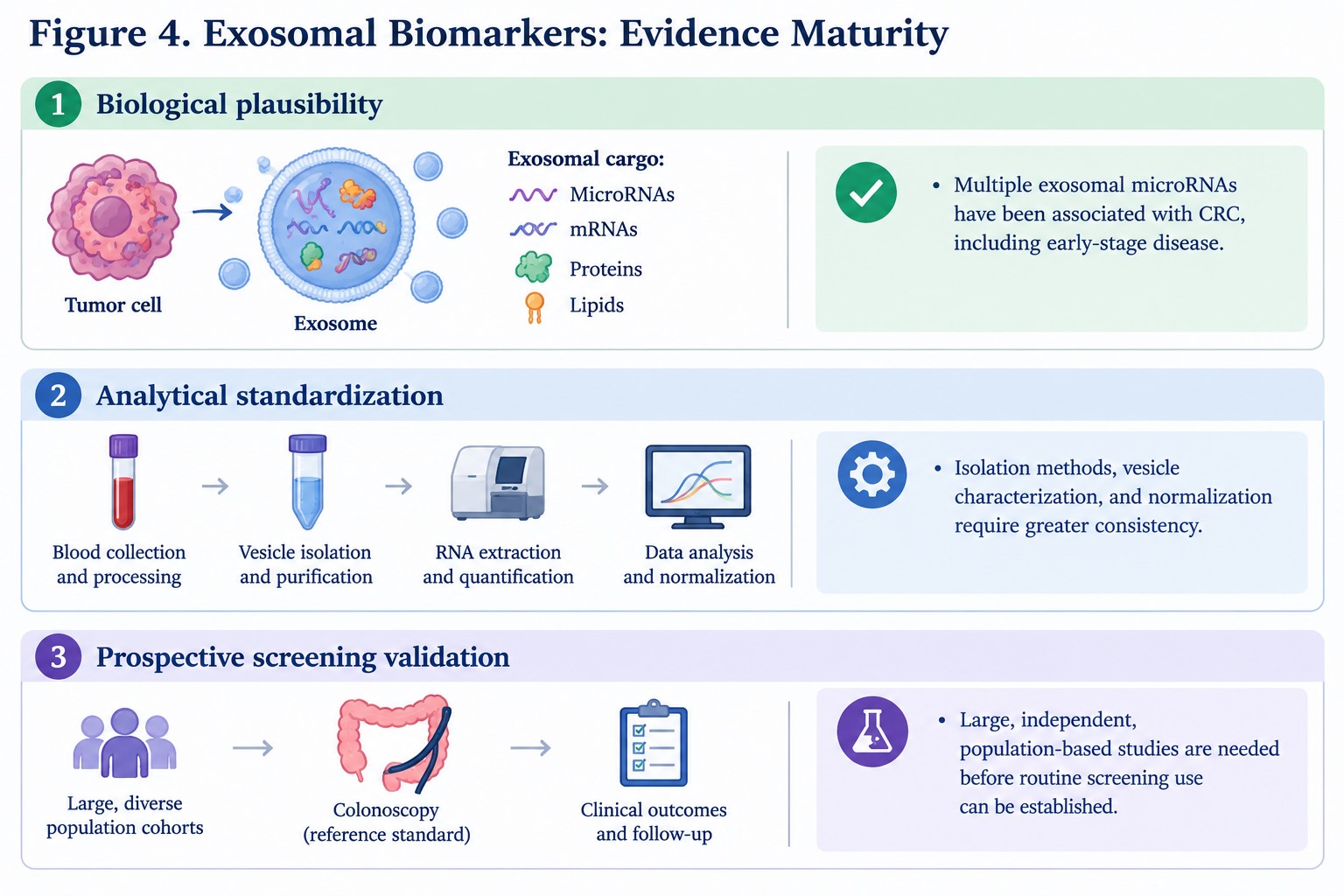
Results: ctDNA assays detect tumor-associated mutations, methylation patterns, and frag entomic characteristics, whereas Exosomal biomarkers include microRNAs, proteins, and other molecular cargo protected within extracellular vesicles. In the prospective ECLIPSE study, a cell-free DNA blood test demonstrated 83.1% sensitivity for CRC and 89.6% specificity for advanced colorectal neoplasia, but sensitivity for advanced precancerous lesions was only 13.2% (Chung et al., 2024). Exosomal microRNA studies have identified promising candidate panels, although differences in isolation procedures, normalization, and study populations limit cross-study comparability. Combining complementary molecular signals may improve detection, but prospective population-based validation remains essential.

Conclusion: Liquid biopsy has substantial potential as a complementary CRC screening strategy. Its clinical value will depend on reproducible analytical methods, high sensitivity for early-stage disease and advanced precancerous lesions, appropriate specificity in asymptomatic populations, cost-effectiveness, and demonstrated benefits in screening participation and patient outcomes.

Graphical Abstract

Liquid Biopsy for Early Detection of Colorectal Cancer: Circulating Tumor DNA and Exosomal Biomarkers

Keywords

Subjects

[1] Bette Gowda, C., Sausen, M., Leary, R. J., Kinde, I., Wang, Y., Agrawal, N., et al. (2014). Detection of circulating tumor DNA in early- and late-stage human malignancies. Science Translational Medicine, 6(224), 224ra24.
[2] Bossuyt, P. M., Reitsma, J. B., Bruns, D. E., Gatsonis, C. A., Glasziou, P. P., Irwig, L., et al. (2015). STARD 2015: An updated list of essential items for reporting diagnostic accuracy studies. BMJ, 351, h5527.       
[3] Carbone, F., Ciardiello, D., Granieri, S., Fazio, N., Avallone, A., & Delrio, P. (2026). Blood-based circulating tumour DNA (ctDNA) tests for colorectal cancer screening: Systematic review and meta-analysis of diagnostic accuracy. Critical Reviews in Oncology/Hematology, 222, 105289.
[5] Chung, D. C., Gray, D. M., Singh, H., Issaka, R. B., Raymond, V. M., Eagle, C., et al. (2024). A cell-free DNA blood-based test for colorectal cancer screening. The New England Journal of Medicine, 390(11), 973-983.        
[6] Church, T. R., Wandell, M., Lofton-Day, C., Mongin, S. J., Burger, M., Payne, S. R., et al. (2014). Prospective evaluation of methylated SEPT9 in plasma for detection of asymptomatic colorectal cancer. Gut, 63(2), 317-325.        
[7] Cohen, J. D., Li, L., Wang, Y., Thoburn, C., Afsari, B., Danilova, L., et al. (2018). Detection and localization of surgically resectable cancers with a multi-analyte blood test. Science, 359(6378), 926-930.          
[8] Cristiano, S., Leal, A., Phallen, J., Fiksel, J., Adleff, V., Bruhm, D. C., et al. (2019). Genome-wide cell-free DNA fragmentation in patients with cancer. Nature, 570, 385-389.
[9] Samimi, A. (2025). Risk Assessment in Hospitals Using the FMEA Method: A Data-Driven Analysis for Patient Safety Improvement. Journal of Advanced in Medicinal, Pharmaceutical and Biomedical Research (JAMPBR), 1(6), 180-187.
[10] Diehl, F., Schmidt, K., Choti, M. A., Romans, K., Goodman, S., Li, M., et al. (2008). Circulating mutant DNA to assess tumor dynamics. Nature Medicine, 14, 985-990.
[11] Guntupalli, Y., Nimmagadda, R., Potluri, V., Majety, S. K., Mangala Giri, T., Yendluri, A., et al. (2026). Blood-based circulating tumor DNA for early detection of colorectal cancer: A systematic review and meta-analysis. Digestive Diseases, 44(3), 280-297. 
[12] Imperiale, T. F., Porter, K., Zella, J., Gagrat, Z. D., Olson, M. C., Statz, S., et al. (2024). Next-generation multitarget stool DNA test for colorectal cancer screening. The New England Journal of Medicine, 390(11), 984-993. 
[13] Lennon, A. M., Buchanan, A. H., Kinde, I., Warren, A., Thomashefsky, A., Cohain, A. T., et al. (2020). Feasibility of blood testing combined with PET-CT to screen for cancer and guide intervention. Science, 369(6499), eabb9601.
[14] Lo, Y. M. D. (2024). Cell-free DNA for colorectal cancer screening. The New England Journal of Medicine, 390(11), 1047-1050.
[15] Samimi, A. (2025). Application of Failure Mode and Effects Analysis (FMEA) for Risk Management in Hospital Laboratories. Medicinal, Psychological, and Health Research Journal (MPHRJ), 1(5), 160-168.
[16] Ogata-Kawata, H., Izumiya, M., Kurioka, D., Honma, Y., Yamada, Y., Furuta, K., et al. (2014). Circulating Exosomal microRNAs as biomarkers of colon cancer. PLOS ONE, 9(4), e92921.
[17] Shi, Y., Zhuang, Y., Zhang, J., Chen, M., & Wu, S. (2021). Four circulating Exosomal miRNAs as novel potential biomarkers for the early diagnosis of human colorectal cancer. Tissue and Cell, 70, 101499.          
[18] Sung, H., Ferlay, J., Siegel, R. L., Laversanne, M., Seromata, I., Jemal, A., & Bray, F. (2021). Global cancer statistics 2020: GLOBOCAN estimates of incidence and mortality worldwide for 36 cancers in 185 countries. CA: A Cancer Journal for Clinicians, 71(3), 209-249.        
[19] Théry, C., Witwer, K. W., Aikawa, E., Alcaraz, M. J., Anderson, J. D., Andriantsitohaina, R., et al. (2018). Minimal information for studies of extracellular vesicles 2018 (MISEV2018): A position statement of the International Society for Extracellular Vesicles. Journal of Extracellular Vesicles, 7(1), 1535750.
[20] Tie, J., Wang, Y., Tomasetti, C., Li, L., Springer, S., Kinde, I., et al. (2016). Circulating tumor DNA analysis detects minimal residual disease and predicts recurrence in patients with stage II colon cancer. Science Translational Medicine, 8(346), 346ra92. 
[21] Wan, J. C. M., Massie, C., Garcia-Corbacho, J., Mouliere, F., Brenton, J. D., Caldas, C., et al. (2017). Liquid biopsies come of age: Towards implementation of circulating tumour DNA. Nature Reviews Cancer, 17, 223-238.            
[22] Whiting, P. F., Rutjes, A. W. S., Westwood, M. E., Mallett, S., Deeks, J. J., Reitsma, J. B., et al. (2011). QUADAS-2: A revised tool for the quality assessment of diagnostic accuracy studies. Annals of Internal Medicine, 155(8), 529-536.
[23] Gopal, P., Ahmed, Z., Kant, V. V. R., Rao, G. V., & Rebala, P. (2023). Circulating tumor DNA for monitoring colorectal cancer: A prospective observational study to assess the presence of methylated SEPT9 and VIM promoter genes and its role as a biomarker in colorectal cancer management. Turkish Journal of Surgery, 39(2), 107-114.             
[24] You, S. W., Kang, S. L., Kwon, J. Y., et al. (2026). Diagnostic accuracy of liquid biopsy-based qPCR, ddPCR, and NGS in colorectal cancer: A systematic review and meta-analysis. Journal of Biological Engineering.    
[25] Diagnostic performance of various liquid biopsy methods in detecting colorectal cancer: A meta-analysis. (2020). Cancer Medicine, 9(16), 5699-5707.     
[26] Samimi, A. (2025). Assessment of Risks Arising from Neuropsychological Crises in Cardiac Patients Using FMEA. Journal of Advanced in Medicinal, Pharmaceutical and Biomedical Research (JAMPBR), 1(7), 196-203.

Articles in Press, Accepted Manuscript
Available Online from 03 November 2026