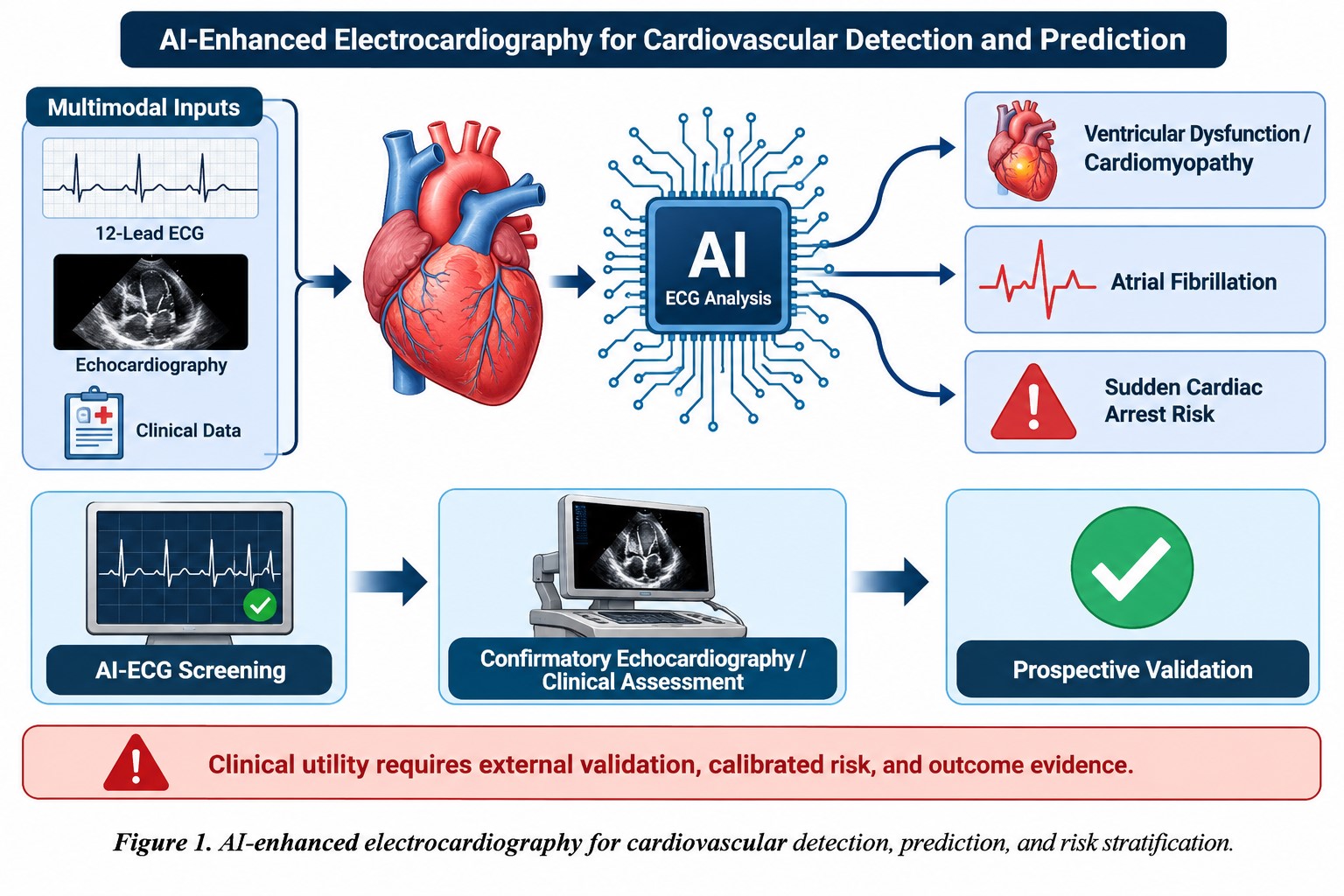
Cardiovascular disease (CVD) remains the leading cause of global mortality, yet conventional diagnostic and risk-stratification paradigms frequently fail to identify high-risk individuals before adverse events occur. Artificial intelligence (AI) has emerged as a transformative technology capable of extracting latent diagnostic and prognostic information from routine clinical data, imaging, and multi-omics profiles. This review synthesizes current evidence on AI applications across three interconnected domains: predictive biomarker discovery, early disease detection, and personalized clinical risk assessment. Deep learning models applied to electrocardiography can identify subclinical ventricular dysfunction, atrial fibrillation, and structural heart disease with performance exceeding conventional interpretation. In cardiac imaging, AI enables automated quantification, plaque characterization, and detection of prognostically significant features invisible to human readers. Multi-omics integration through frameworks such as CardiOmicScore demonstrates that proteomic and metabolomic risk scores substantially enhance predictive accuracy up to 15 years before disease onset. Machine learning models incorporating clinical, lifestyle, and genetic data achieve area under the curve values of 0.85 for composite CVD prediction, outperforming the Framingham Risk Score by a clinically meaningful margin. Despite these advances, critical barriers persist: the predominance of retrospective single-center studies, limited external validation, demographic bias in training datasets, and a paucity of prospective implementation trials demonstrating outcome improvement. This review critically evaluates the current landscape, identifies methodological limitations, and proposes a translational framework prioritizing multicenter validation, explainability, and workflow integration to realize AI''s potential for precision cardiovascular prevention.
Maleki, R. (2026). Artificial Intelligence in Cardiovascular Disease Diagnosis: Predictive Biomarkers, Early Detection, and Personalized Clinical Risk Assessment. Eurasian Journal of Chemical, Medicinal and Petroleum Research, (), 241–254. https://doi.org/10.5281/zenodo.24632201
MLA
Maleki, R. "Artificial Intelligence in Cardiovascular Disease Diagnosis: Predictive Biomarkers, Early Detection, and Personalized Clinical Risk Assessment", Eurasian Journal of Chemical, Medicinal and Petroleum Research, , 2026, 241–254. doi: 10.5281/zenodo.24632201
HARVARD
Maleki, R. (2026). 'Artificial Intelligence in Cardiovascular Disease Diagnosis: Predictive Biomarkers, Early Detection, and Personalized Clinical Risk Assessment', Eurasian Journal of Chemical, Medicinal and Petroleum Research, (), pp. 241–254. doi: 10.5281/zenodo.24632201
CHICAGO
Maleki, R., "Artificial Intelligence in Cardiovascular Disease Diagnosis: Predictive Biomarkers, Early Detection, and Personalized Clinical Risk Assessment." Eurasian Journal of Chemical, Medicinal and Petroleum Research, (2026): 241–254, doi: 10.5281/zenodo.24632201
VANCOUVER
Maleki R. Artificial Intelligence in Cardiovascular Disease Diagnosis: Predictive Biomarkers, Early Detection, and Personalized Clinical Risk Assessment. Eurasian J. Chem. Med. Pet. Res. 2026;():241–254. doi: 10.5281/zenodo.24632201